Case Study 2.4: Compressing a Billion Embeddings
Concept. A float32 vector index stores more precision than search needs. Naive rounding fails because most variance lies along a few directions. TurboQuant rotates the vectors so their coordinates follow the same predictable distribution in high dimensions. One scalar quantizer can then compress every coordinate without a trained codebook, shrinking the index by 8 to 32 times.
Intuition. The Bay Area varies mostly north to south and much less east to west. Coarse axis-aligned rounding can collapse San Francisco and Berkeley into one cell. Rotating the coordinate system preserves every point and distance while spreading the east-west difference across multiple coordinates. A few bits per coordinate can then preserve their separation.
A 100,000-document demo becomes a 60 GB index
A semantic-search demo runs instantly on 100,000 documents. In production, the corpus reaches 10 million documents and the raw float32 vector index no longer fits in memory. The memory requirement breaks the design.
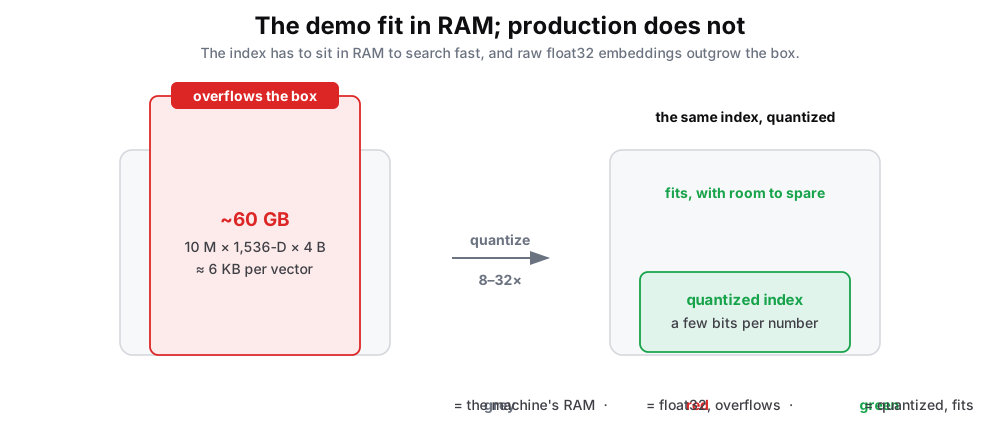 Figure: The demo fit in RAM; production does notThe index has to sit in RAM to search fast. The raw float32 index, about 60 GB for 10 million 1,536-D vectors at 4 bytes each (about 6 KB per vector), does not fit in the machine's RAM. Quantizing, 8 to 32 times smaller, gives the same index at a few bits per number, which fits with room to spare. Color key: grey is the machine's RAM, red is float32 that does not fit, green is quantized and fits.
Figure 1. A full-precision embedding is big. Most have about a thousand dimensions or more. OpenAI's smaller embedding model is 1,536-D and the large one is 3,072-D. At 1,536-D float32 that is about 6 KB per vector, so 10 million vectors take ~60 GB in RAM for fast search. The large model uses double. Quantizing each coordinate to a few bits shrinks the index 8 to 32 times and brings it under the RAM limit.
Most of the information hides in a few directions
Quantization rounds each coordinate to a few bits. Embedding variance is uneven: a few directions carry most of the signal.
Use two dimensions to see the problem. The Bay Area runs mainly north to south, so most location variance lies on that axis. Coarse rounding spends most of its resolution there and little from east to west. San Francisco and Berkeley can therefore land in the same cell even though they are not close in east-west.
Google's TurboQuant (2026) rotates each vector before rounding. Equivalently, rotate the grid while holding the points fixed. The points and distances stay unchanged, but the variance spreads across both axes. San Francisco and Berkeley now land in different cells.
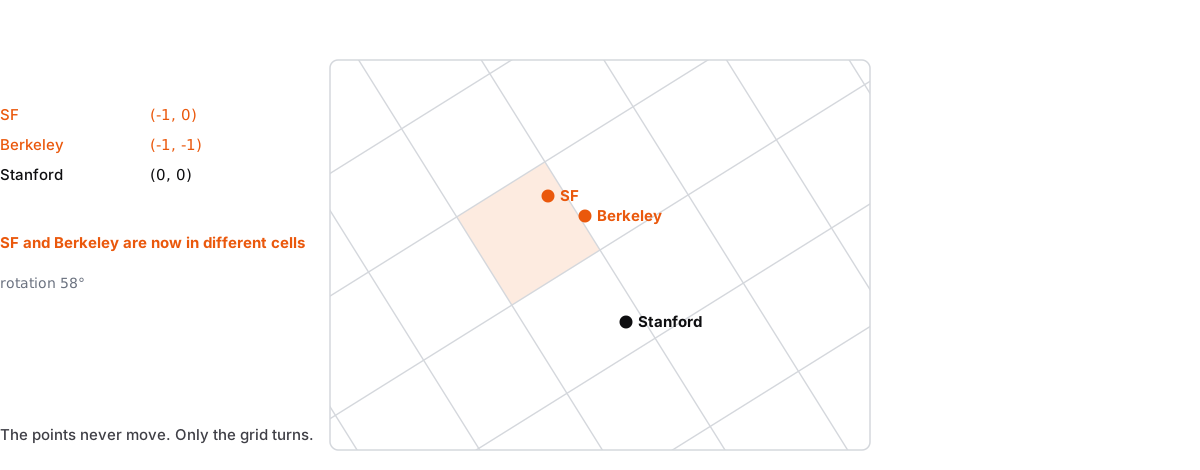 Figure: A random spin turns the grid, not the pointsOne panel. San Francisco, Berkeley and Stanford stay at the same coordinates in every frame while the grid behind them rotates. SF and Berkeley begin in one cell and end in different cells after a spin of 58 degrees; Stanford, much further away, is unaffected. A read-out lists the cell each city falls in.
Figure 2. Eight frames from 0° to 58°. The three cities sit at identical coordinates in every frame, so you can check for yourself that only the grid moved. San Francisco and Berkeley begin in one cell and end in different ones. Stanford, much further off, is untouched.
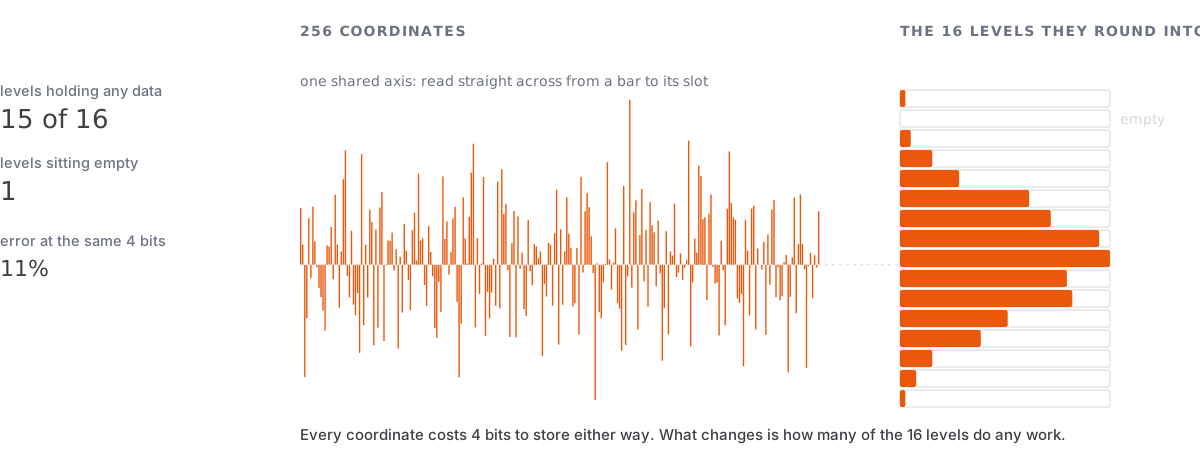 Figure: Four bits buys 16 levels. Before the rotation, 5 get used.256 embedding coordinates drawn as bars, beside a histogram of how many fall into each of the 16 levels a 4-bit quantiser offers. Before the rotation the coordinates are dominated by a few large ones, so only 5 of the 16 levels are ever used and one level holds most of them. After a random rotation the coordinates are evenly spread and 15 of the 16 levels are in use. Storage is 4 bits per coordinate in both cases.
Figure 2b. The same idea at 256 dimensions. A 4-bit budget is 16 levels. Before the rotation the coordinates are so uneven that only 5 levels are ever used, which is 2.3 bits of information in the 4 bits you are paying to store. After it, 15 levels are in play at 3.9 bits. Storage is 4 bits per coordinate either way; only the useful fraction changes.
The map supplies only a two-dimensional intuition. Real embeddings have hundreds or thousands of dimensions. A single rotation is ineffective in two dimensions. Across hundreds of dimensions, the rotations help.
Drop the precision
With the variation spread more evenly, we then quantize (round) each coordinate to fewer bits. Think of this step like how we can make a high-resolution image to a lower-res image and make it smaller.
 Figure: Drop the precision, keep the distanceA coordinate stored today as 0.4327 uses 32 bits per number, the exact coordinate. After quantizing it is stored as 10: 2 bits, bucket 2 of 4, which decodes back to about 0.4. The distance between two vectors barely moves, because after the spin no single coordinate carries the answer. Sixteen times smaller, and no codebook to train. Color key: orange is the quantized value.
Figure 3. Scalar quantization of one coordinate. 0.4327 stored in 32 bits maps to a 2-bit bucket 10 and decodes to about 0.4. One coordinate is now rough, but a distance adds up hundreds of them, and the rounding errors mostly cancel out. The rotation first spreads the values evenly, so one simple quantizer fits every coordinate and every dataset, with no training. Two bits gives 16× compression, and one bit gives 32×.
Like LSH, the rotation is random and does not inspect the dataset. LSH uses randomness to bucket similar items. TurboQuant uses it to spread information before rounding. Google Research calls the method TurboQuant (ICLR 2026): spin, then round.
Try it yourself?
The cost in recall, the fraction of exact nearest neighbours returned, depends on the data. Measure it on your own corpus. FAISS implements this recipe, a random rotation followed by scalar quantization, in a few lines, making it a one-afternoon experiment. You oculd experiment with the same tradeoff in Project 2's NanoMem Systems track, where an AI agent's memory engine must fit within a tight memory budget.
Takeaway: Spin, then round. Rotation spreads the embedding's information across coordinates, so a shared low-bit quantizer can shrink the index by 8 to 32 times without training a codebook. Like LSH, TurboQuant uses randomness to avoid learning from the dataset, but for a different purpose.
Video
Play video: 📘 Case Study 2.4: Compressing a Billion Embeddings