Welcome to Modern Data Systems: CS145
We rebuilt CS145 as a modern data systems course for the agent era. Earlier versions focused on web and cloud systems.
 Figure: Twenty questions modern data systems answerTwenty course questions in four columns: AI agent data stacks, reads at scale, writes at scale, and trust, security, and streaming. Each question names the techniques the course uses to answer it.
Figure 1. CS145 starts with twenty production questions. Each answer introduces a systems technique you can reuse.
The course organizes modern data systems around these twenty questions. Each connects a production requirement to the mechanism that satisfies it. The Modules page lists every question and the level of the stack where the course answers it.
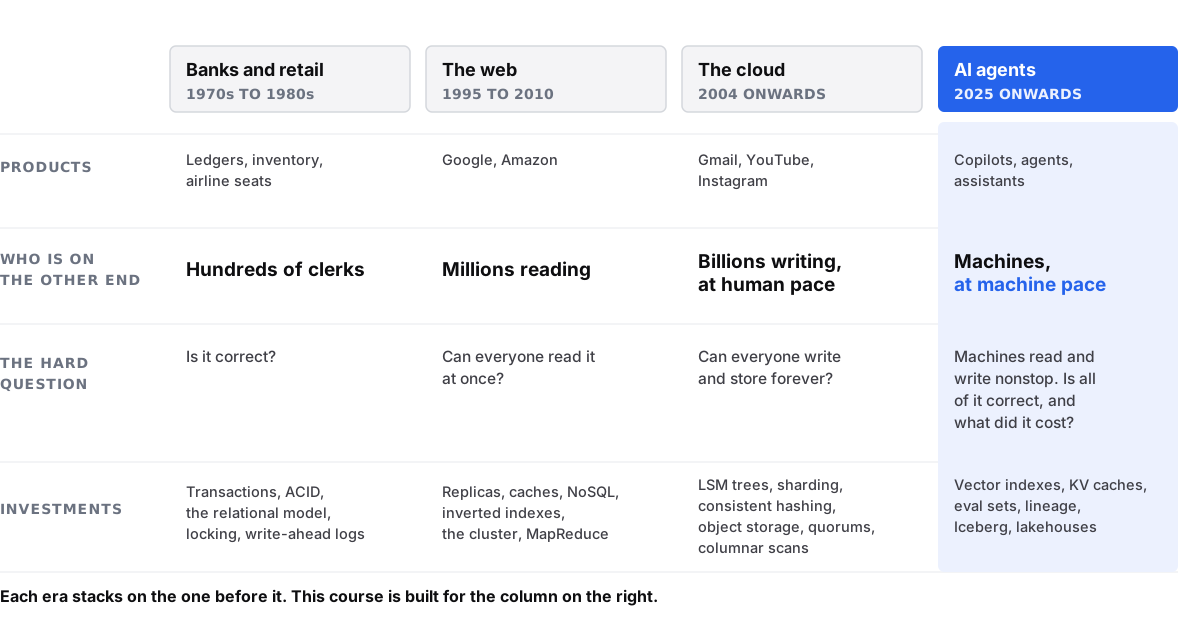 Figure: Four eras of data systems, compared on the same four questionsA four-column grid. The columns are Banks and retail in the 1970s to 1980s, the web from 1995 to 2010, the cloud era from 2004 onwards, and AI agents from 2025 onwards, the last one filled blue as the era the course is built for. Four rows compare them: the products of each era, who is on the other end of the query, the hard question each era had to answer, and what the industry invested in during it. The middle row escalates from hundreds of clerks, to millions reading, to billions writing at human pace, to machines at machine pace. The investments row runs from transactions and the relational model, through replicas and NoSQL and MapReduce, to LSM trees and object storage and columnar scans, to vector indexes and KV caches and lineage and Iceberg, the table format that lets any engine read the same storage.
| Banks and retail | The web | The cloud | AI agents |
|---|---|---|---|
| 1970s TO 1980s | 1995 TO 2010 | 2004 ONWARDS | 2025 ONWARDS |
Figure 2. Each era shifted the party issuing the query. CS145 targets the agent era.
The rest of this page is how the class runs. For who built it and how the site is put together, see About.
Before You Start
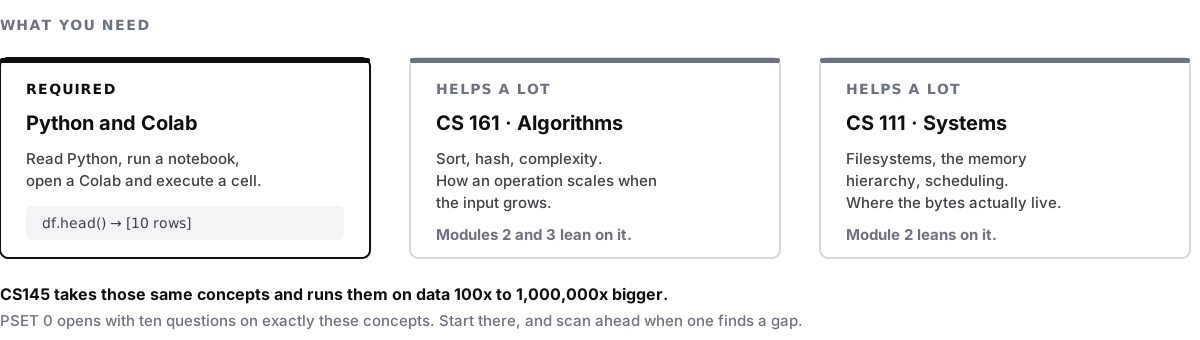 Figure: What you need on day one, and what helps a lotThree panels. The first, with an ink top strip marking it as required, is Python and Colab: read Python and run a notebook, needed from day one. The next two, with grey strips marking them as helpful rather than required, are CS 161 Algorithms, giving sort and hash and complexity, and CS 111 Systems, giving filesystems and the memory hierarchy and scheduling. A closing line says CS145 runs those same concepts on data 100 to 1,000,000 times bigger, and points at the ten-question concept check that opens PSET 0.
| REQUIRED | HELPS A LOT | HELPS A LOT |
|---|---|---|
| Python and Colab | CS 161 · Algorithms | CS 111 · Systems |
Figure 3. The course leans on the concepts from CS161 and CS111 more than the coursework. Use PSET 0 to check where you stand.
How It Works
Every week runs the same three steps, in this order: you follow the lectures, you practice in section, and you read on your own time. Week 7 has a single lecture. The page used in lecture is the page you read afterward, at the same URL.
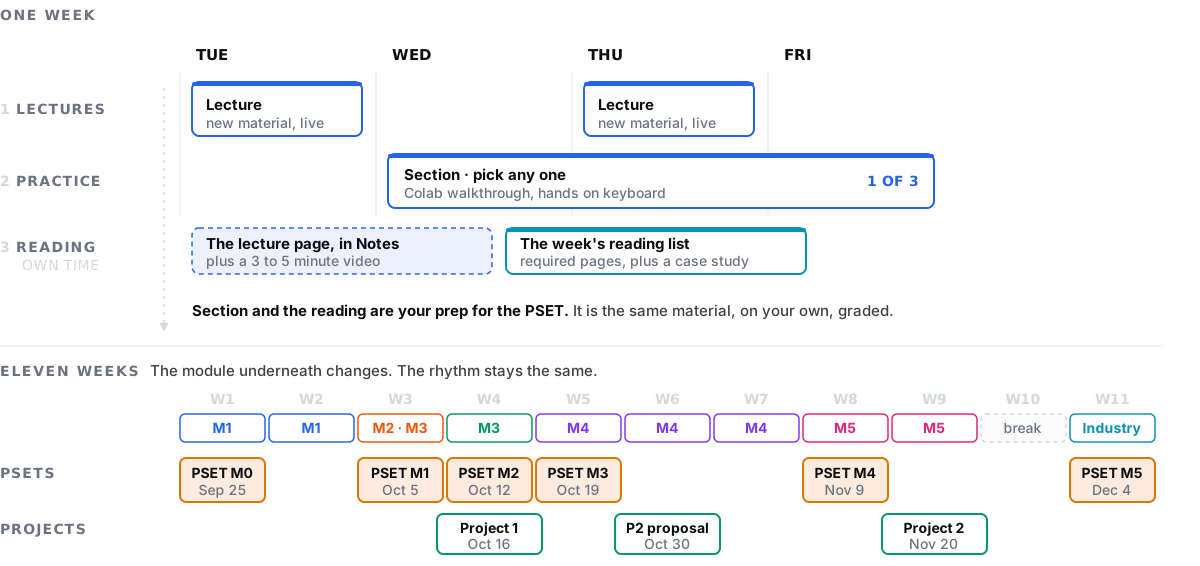 Figure: One week in CS145, and the eleven weeks it repeats acrossTwo blocks in one picture. The top block is one week in three lanes, read top to bottom in the order you do them. LECTURES holds the two lectures, Tuesday and Thursday. PRACTICE shows section slots on Wednesday and Friday running the same Colab walkthrough. Students pick one slot; timings are on Ed. READING holds the same page used in lecture with its three to five minute video, and the week's industry case study. Between them, a line says section and the reading are the rehearsal and the PSET is the same material on your own, graded. The bottom block is the quarter: eleven week columns with the module each covers, M1 SQL through M5 Distributed, a Thanksgiving gap at week ten and industry lessons at week eleven, then two rows of real deadlines. Six PSETs: M0 Sep 25, M1 Oct 5, M2 Oct 12, M3 Oct 19, M4 Nov 9, M5 Dec 2, each landing the week after its module ends. Three project milestones: Project 1 Oct 16, the Project 2 proposal Oct 30, and Project 2 Nov 20.
| W1 | W2 | W3 | W4 | W5 | W6 | W7 | W8 | W9 | W10 | W11 |
|---|---|---|---|---|---|---|---|---|---|---|
| M1 | M1 | M2 · M3 | M3 | M4 | M4 | M4 | M5 | M5 | break | Industry |
| PSET M0 | PSET M1 | PSET M2 | PSET M3 | PSET M4 | PSET M5 |
|---|---|---|---|---|---|
| Sep 25 | Oct 5 | Oct 12 | Oct 19 | Nov 9 | Dec 2 |
| Project 1 | P2 proposal | Project 2 |
|---|---|---|
| Oct 16 | Oct 30 | Nov 20 |
| TUE | WED | THU | FRI |
|---|---|---|---|
| Lecture | Section slots | Lecture | Section slots |
| new material, live | Colab walkthrough | new material, live | Colab walkthrough |
Figure 4. Section and the reading are your prep for the graded PSET. Lectures run Tuesday and Thursday; pick one section slot (timings on Ed). The bottom block is that same week across all eleven: a PSET follows its module.
How Grading Works
CS145 calculates two grading paths and automatically uses the higher score.
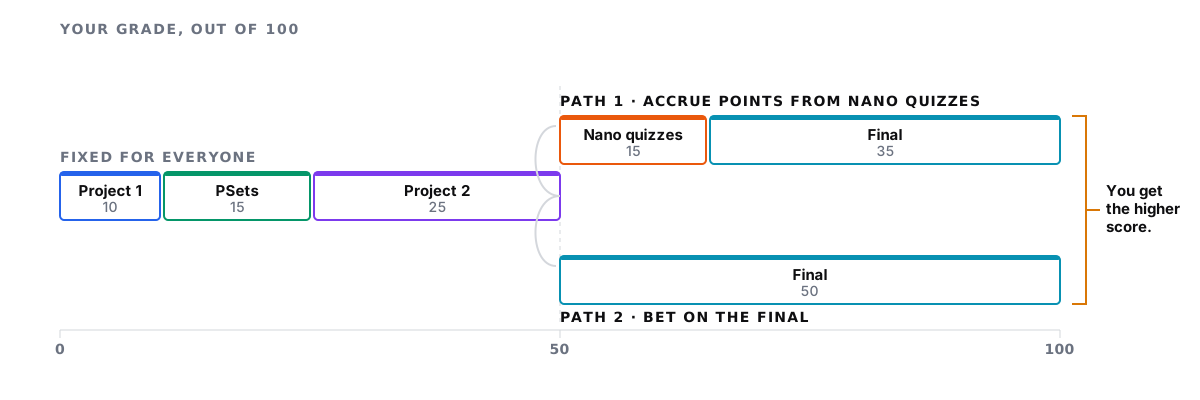 Figure: One hundred points: fifty fixed, and fifty you can earn two different waysA hundred-point scale. The first fifty points are fixed for everyone: Project 1 worth ten, PSets worth fifteen, Project 2 worth twenty-five. From the fifty-point mark the bar splits into two alternatives for the remaining fifty. Path 1 accrues fifteen points from nano quizzes and puts thirty-five on the final. Path 2 is a final worth fifty. A brace on the right marks that you are given whichever of the two scores higher, automatically.
| Nano quizzes | Final |
|---|---|
| 15 | 35 |
| Project 1 | PSets | Project 2 | You get |
|---|---|---|---|
| 10 | 15 | 25 | the higher |
| Final |
|---|
| 50 |
Figure 5. Everyone earns 50 fixed points: Project 1 for 10, PSets for 15, Project 2 for 25. The remaining 50 points come from either Path 1 or Path 2, and the course uses the higher score. Path 1 accrues 15 points from nano quizzes across the term and puts 35 on the final. Path 2 assigns all 50 to the final.
Nano quizzes begin in Week 2. They are completion-graded submitted with your Stanford email. Each lecture quiz is worth 0.5 points (18 quizzes, 9 points available), and each section quiz is worth 0.75 points (10 quizzes, 7.5 points available). We cap the total at 15 of the 16.5 available points, so you can miss a few. Everyone receives full credit for Lecture 2 and the Week 1 section.
Lecture quizzes close at 6:30 pm Pacific on the day of lecture; students watching synchronously on Panopto may submit them. For section, the CA shares a password during the first hour, and credit requires attending that full hour. Do not share quiz links or section passwords. There are no makeups. See the nano-quiz announcement on Ed for full details.
Grade = Projects + PSets + max(Final @ 35% + Quizzes @ 15%, Final @ 50%)
Grade scale
-
≥ 97: A+, ≥ 93: A, ≥ 90: A−
-
≥ 87: B+, ≥ 83: B, ≥ 80: B−
-
≥ 77: C+, ≥ 73: C, ≥ 70: C−
-
≥ 60: D, < 60: F
P/NP: need at least a C− (≥ 70) to pass.
Units
4 units is the default. The material and pacing match 4 units. You may enroll for 3. The course expectations stay the same.
Final Exam
Exam conflict policy: no rescheduling of the final exam.
-
OAE accommodations: same day, extended hours, alternate location
-
Verify conflicts before enrolling in CS145
-
For illness or emergencies on exam day, see the "When life gets in the way" section below
When life gets in the way
The class offers built-in slack: 2 PSET late days, 2 project late days, Path 2, and CA sessions.
For final-exam emergencies, please contact us through a private Ed post or email the course staff directly.
Incompletes from a missed final resolve the next time CS145 runs (usually once a year). See Stanford's Incomplete policy and talk to your undergrad advisor.
Frequently Asked Questions
Q: What time are PSETs and projects due?
PSETs and projects are due at 11:59 pm Pacific on the stated deadline. You have 2 PSET late days and 2 project late days for the quarter; they cannot be exchanged. Each adds exactly 24 hours, including weekends and holidays. Use one day on each of two assignments or both on one, within the same category. Submissions beyond your allowed extension receive no credit. No late days apply to the Project 2 proposal, due October 30 at 11:59 pm Pacific.
In case of extenuating circumstances, only the head CA can grant additional extensions. Please reach out through a private Ed post before the deadline, or as soon as you can if circumstances prevent that.
Q: Are lectures and sections optional?
Yes. If you miss class, Path 2 applies automatically. No form and no penalty. If you attend, live nano quizzes can lower the final's weight from 50% to 35%. You are responsible for the material either way. It carries into your PSets, your projects, and every assessment.
Q: Why nano quizzes?
Nano quizzes are a low-stakes way to help you stay in sync with the course material. Together they are worth 15 points, so there is no separate midterm. Path 2 covers missed quizzes automatically.
Q: I'm a CGOE student or can't get to campus. Can I still take the course?
Yes. Every lecture page and its three-to-five-minute video are available on this site. Every lecture will be on Canvas. At least one of the section walkthroughs will be posted as a video on Ed. All PSets and projects are submitted online. Path 2 applies automatically, with the final worth 50%.
Q: How should I prepare for the final exam?
The PSETs and your project work provide the best preparation. See CS145 Exam Prep for the exam format and practice-exam release timing.
Q: Are there PDFs?
Yes. The live slides are usually the best version because they stay current and include the interactive material. If you prefer a fixed, printable copy, use the lecture PDF archive.
Q: Can I audit the class?
Stanford community members are welcome to audit CS145 and complete the PSets. Sign up over here with your Stanford account. We periodically add auditors to Ed and Canvas. We cannot accept project or exam submissions from auditors.
Q: Do I have to choose a path?
No. At the end of the course, we calculate both totals and you get the higher one. Nano quizzes can only improve your Path 1 score.
Q: I missed a lecture. How do I catch up?
Open the Schedule and find the pages listed for that day. Each page includes a short video. For section, use the posted Colab walkthroughs and run the notebook when convenient. Path 2 automatically accounts for the missed quiz points.
Accessibility
Students with OAE needs are a valued part of Stanford. If you already have an Academic Accommodation Letter, upload it to Gradescope at the earliest opportunity so we can partner with you and OAE to identify any barriers to access in this course.
OAE accommodations apply to the final exam (extended time, alternate location, alternate timing) and to deadline accommodations on PSets and projects.
AI Policy: Learn Like You'll Work
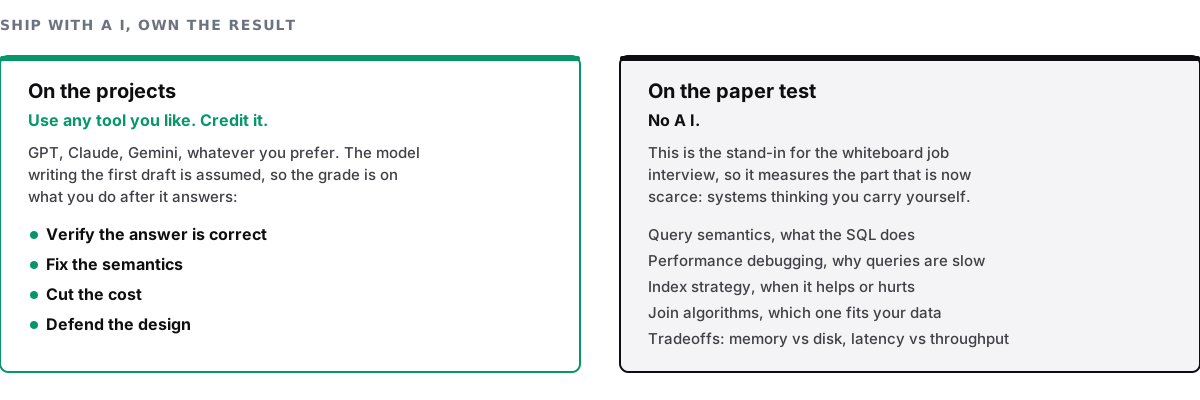 Figure: Where AI is allowed in CS145, and what is graded in each placeTwo panels. On the left, the projects: every AI tool is allowed, credited, and the grade is on four things you do after the model answers, namely verify the answer, fix the semantics, cut the cost, and defend the design. On the right, the paper test: no AI, standing in for a whiteboard interview and measuring the systems thinking you carry yourself.
| On the projects | On the paper test |
|---|---|
| Use any tool you like. Credit it. | No A I. |
Figure 6. On projects, draft your code first, then any AI tool and credit it; your grade is on verifying the answer, fixing the semantics, cutting cost, and defending the design. The paper test is AI-free, a stand-in for the whiteboard interview.
Teaching Team

 Ananya Ganapathi
 Aryan Katiyar

 Jason Shin
 Qirui Zheng

 Yufei Liu