Sort-Merge Join: When Order Matters
Concept. Sort-merge join sorts both tables on the join key, then scans them in lockstep and emits matching rows for equal keys.
Intuition. When you need to join Users to Listens by user_id and one or both is already sorted (or you have to sort anyway), sort both, then walk them like merging two sorted lists. Mickey's Users row meets Mickey's Listens rows at the same point in the walk.
The Sort-Merge Join Algorithm
Sort both tables on the join key with BigSort, then walk them in lockstep with two pointers, matching as you go.
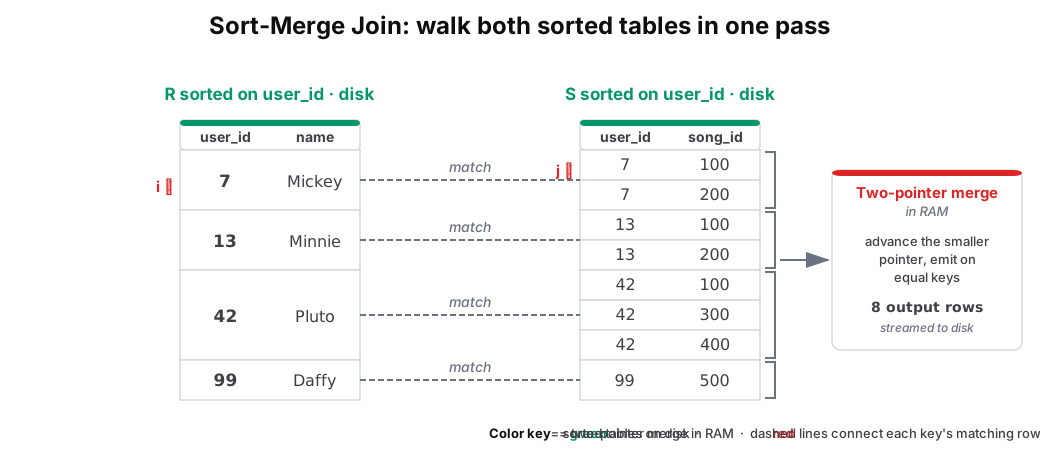 Figure: Sort-Merge Join: after Phase 1 BigSort, both R and S are sorted on disk on the join keySort-Merge Join: after Phase 1 BigSort, both R and S are sorted on the join key and live on disk. Phase 2 walks both tables in one pass with two pointers in RAM, emitting matched groups as it goes. The dashed match lines connect each key's R row to its matching S rows: key 7 yields 2 outputs, key 13 yields 2, key 42 yields 3, key 99 yields 1. Total 8 output rows. Color key: green is the sorted tables on disk (persistent), red is the two-pointer merge in RAM (volatile).
Figure 1. Sort-Merge Join, R ⋈ S on user_id (Phase 2 shown). Phase 1 (not shown) BigSorts both R and S on the join key (see the big sort page). Phase 2 scans the two sorted runs with two pointers. Equal keys form a matching key group, and the operator emits every pair in the group. Unequal keys advance the smaller side. The example advances through user_id 7 → 2, 13 → 2, 42 → 3, 99 → 1, total 8 rows. A key that appears on only one side emits nothing under inner join semantics. A key with m matches on one side and n on the other emits the m × n cross-product for that key. The output stream stays sorted on the join key, so a downstream operator that requires that order does not add a sort. Best case is P(R) + P(S) + OUT for one linear scan per run, plus the two Phase-1 BigSort costs. Worst case is O(P(R) × P(S)) + OUT when one key dominates and the merge performs a per-key cross-product. OUT can dominate when match rates are high.
Algorithm · Sort-Merge Join
SortMergeJoin(T1, T2, key):           // assume |T1| < |T2|

    Phase 1: Sort both tables on the join key
    S1 = BigSort(T1, key)
    S2 = BigSort(T2, key)

    Phase 2: Walk both runs in lockstep
    i = 0, j = 0
    while i < |S1| and j < |S2|:
        if S1[i].key < S2[j].key: i++
        elif S1[i].key > S2[j].key: j++
        else:                          // keys match
            output all pairs (S1[i..i'], S2[j..j'])
            where S1[i..i'].key = S2[j..j'].key
            i = i'+1, j = j'+1
Multi-Table Sort-Merge Joins
Three-Way Join: Users, Listens, Songs
Sequential Approach
Algorithm · Three-Way Join
ThreeWayJoin(U, L, S):              // assume |U| < |L| < |S|
    temp   = SMJ(U, L, 'user_id')   // U ⋈ L
    result = SMJ(temp, S, 'song_id')   // temp ⋈ S
    return result