Hash Partition Join
Concept. Hash partition join joins two tables that do not fit in RAM. It hashes both tables on the join key into matching partitions, then joins each partition pair independently.
Intuition. When both Users and Listens exceed RAM, hash user_id % 16 to split each table into 16 partitions. Mickey's Users row and Mickey's Listens rows map to the same partition, so a join can run on partition 1 with partition 1 in RAM, then 2 with 2, and so on. Cost: 3(N+M) IOs.
When Both Tables Don't Fit in Memory
The query we want to run:
SELECT u.name, l.song_id, l.rating
FROM Users u
JOIN Listens l ON u.user_id = l.user_id;
If Users is 100 GB and Listens is 800 GB but RAM is only 64 GB, neither side fits in memory. BNLJ would re-scan the larger side once per outer block, which would waste I/Os.
Hash Partition Join: The Solution
Core Insight
Partition both tables using the same hash function on the join key. Rows from each side with the same key land in the same partition number, so matching can happen one partition at a time, in RAM.
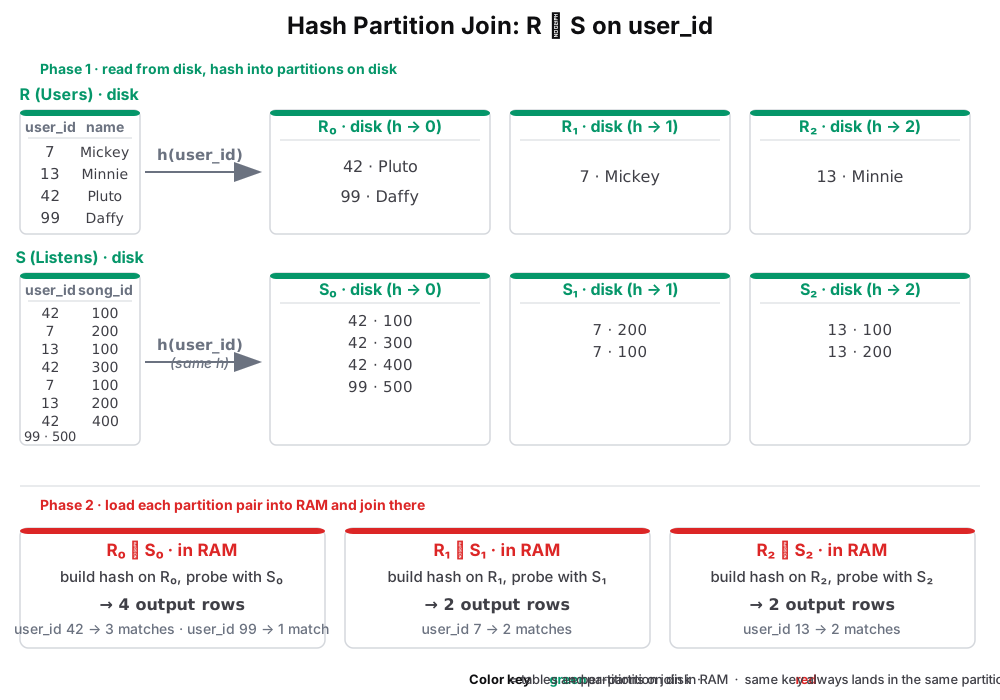 Figure: Hash Partition Join: in Phase 1 both R and S are hashed on the join key into matching partitions on disk; in Phase 2 each partition pair is joined in RAMHash Partition Join. Phase 1: both R and S are read from disk and hashed on the join key into matching partitions written back to disk, so the same key always lands in the same partition number. Phase 2: each partition pair is loaded into RAM and joined there. Color key: green is the tables and partitions on disk (persistent), red is the per-partition join in RAM (volatile); partitions are identified by their h to 0, 1, 2 labels.
| user_id | name |
|---|---|
| 7 | Mickey |
| 13 | Minnie |
| 42 | Pluto |
| 99 | Daffy |
| user_id | song_id |
|---|---|
| 42 | 100 |
| 7 | 200 |
| 13 | 100 |
| 42 | 300 |
| 7 | 100 |
| 13 | 200 |
| 42 | 400 |
| 99 | 500 |
| R₀ · disk (h → 0) |
|---|
| 42 · Pluto |
| 99 · Daffy |
| R₁ · disk (h → 1) |
|---|
| 7 · Mickey |
| R₂ · disk (h → 2) |
|---|
| 13 · Minnie |
| S₀ · disk (h → 0) |
|---|
| 42 · 100 |
| 42 · 300 |
| 42 · 400 |
| 99 · 500 |
| S₁ · disk (h → 1) |
|---|
| 7 · 200 |
| 7 · 100 |
| S₂ · disk (h → 2) |
|---|
| 13 · 100 |
| 13 · 200 |
| R₀ ⋈ S₀ · in RAM | R₁ ⋈ S₁ · in RAM | R₂ ⋈ S₂ · in RAM |
|---|---|---|
| build hash on R₀, probe with S₀ | build hash on R₁, probe with S₁ | build hash on R₂, probe with S₂ |
| → 4 output rows | → 2 output rows | → 2 output rows |
| user_id 42 → 3 matches · user_id 99 → 1 match | user_id 7 → 2 matches | user_id 13 → 2 matches |
Figure 1. Hash Partition Join, R ⋈ S on user_id. Phase 1 hashes both tables with the same function so matching user_ids always land in the same partition number. Phase 2 joins each (Rᵢ, Sᵢ) pair independently in RAM, building a hash table on R and probing with S, three parallelizable joins that yield 4 + 2 + 2 = 8 rows. Best-case cost is 3(N+M) + OUT (read each table, write partitions, read them back, write the output). The worst case is hash skew, where a hot key overflows a partition past RAM and recursive re-partitioning or a sort-merge fallback adds another pass.
Algorithm · Hash Partition Join
HashPartitionJoin(T1, T2, key):       // assume |T1| < |T2|
    B = choose_partition_count(T1, RAM) // allow space for the build hash table

    Phase 1: Partition both tables on the same hash
    for row in T1: write to T1_p[h(row.key) % B]
    for row in T2: write to T2_p[h(row.key) % B]    // same hash!

    Phase 2: Join matching partitions in RAM
    for i in 0..B-1:
        HT = hash_table(T1_p[i])      // build on the smaller side
        for row in T2_p[i]:           // probe with the larger
            if HT[row.key]: output matches
Multi-Table Joins
Joining Three Tables: Users, Listens, Songs
Algorithm · Three-Way Join
ThreeWayJoin(U, L, S):              // assume |U| < |L| < |S|
    temp   = HPJ(U, L, "user_id")   // U ⋈ L
    result = HPJ(temp, S, "song_id")   // temp ⋈ S
    return result
Handling Skew in HPJ
-
Memory requirement: the build-side hash table must fit in RAM. The probe side can stream through it, even when that probe partition is large.
-
Many distinct keys in an oversized build partition: another hash function can split the partition further.
-
One repeated hot key: rehashing keeps every copy together. Process that key separately, for example by comparing memory-sized blocks with the matching probe rows. Extra passes and a large result can dominate the cost.