Data Security: Trust No One
Concept. Zero Trust assumes compromise at every layer: network, users, admins, code, and backups. The system verifies every request instead of trusting a boundary. The database stores PII, so one unverified path causes a breach.
Intuition. The 2024 mega-breaches used common failures. National Public Data stored plaintext database passwords in an exposed file. Change Healthcare exposed a remote portal without MFA. Snowflake customers reused stolen credentials on accounts without MFA. Each breach used one surface that a defender treated as trusted.
Three Breaches, Half a Billion Records
The vector is almost never a clever zero-day. It is an unpatched library, a plaintext password, or a missing MFA prompt.
| Breach | Year | Records | Root cause |
|---|---|---|---|
| Equifax | 2017 | 148M SSNs | unpatched Apache Struts bug, pivoted to root on the DB |
| National Public Data | 2024 | 170M people (2.9B records) | plaintext DB passwords in an exposed backend file |
| Change Healthcare | 2024 | 193M medical records | remote portal with no MFA, then ransomware |
| Snowflake / Ticketmaster | 2024 | terabytes exfiltrated | stolen credentials on cloud accounts without MFA |
The average breach cost $4.88M in 2024 (IBM), and the count rose sharply year over year. Every root cause above is a surface someone trusted instead of verifying.
Zero Trust: The Five Surfaces
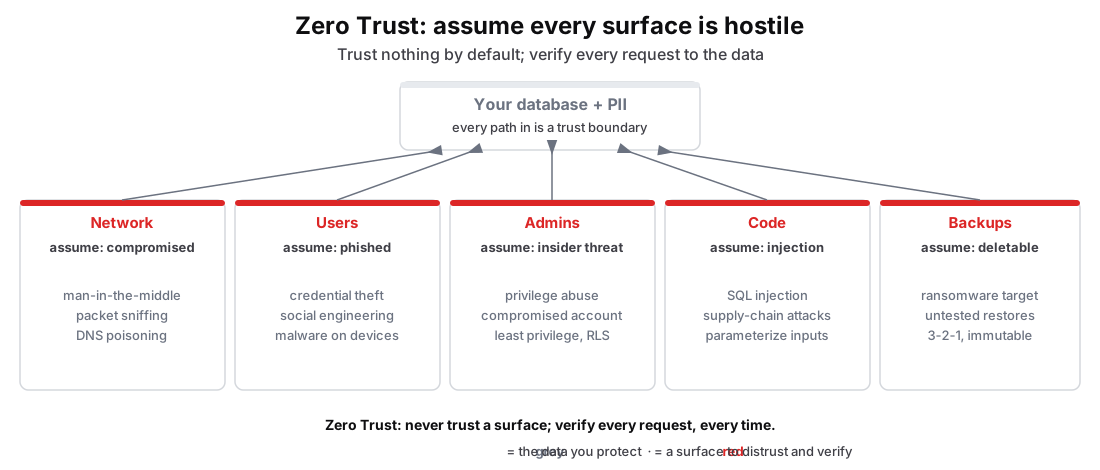 Figure: Zero Trust: assume every surface between a request and the data is already hostileA grey data store at the top holds the database and its PII. Below it sit five red surfaces you must not trust by default: the network (assume compromised), users (assume phished), admins (assume insider threat), code (assume injection), and backups (assume deletable). Zero Trust means verifying every request rather than trusting any of these. Color key: grey is the data you protect, red is a surface to distrust and verify.
Figure 1. Zero Trust treats every path to the data as hostile until verified. Attackers can sniff the network, phish a user, compromise an admin account, inject code, or encrypt backups with ransomware. Defenses verify each request at each surface and apply least privilege, MFA, and immutable backups.
Zero Trust DB Checklist (Starter)
| Priority | Time | Action |
|---|---|---|
| CRITICAL | 5 min | Passwords. Change defaults, set expiry, enforce strong passwords. |
| CRITICAL | 1 hour | Network. Enable SSL/TLS, limit max connections, restrict connection sources. |
| CRITICAL | 10 min | Least privilege. REVOKE ALL ON users FROM public; then GRANT SELECT ON users TO analytics_role; and enable Row-Level Security. |
| HIGH | 5 min | Audit logging. Turn it on. |
| HIGH | 45 min | 3-2-1 backups. 3 copies, 2 storage types, 1 offsite; test restores; keep them immutable against ransomware. |
SQL Injection: The One Bug That Keeps Winning
Injection defense is the clearest case of "verify every input." The classic Bobby Tables attack still works wherever a query is built by string concatenation.
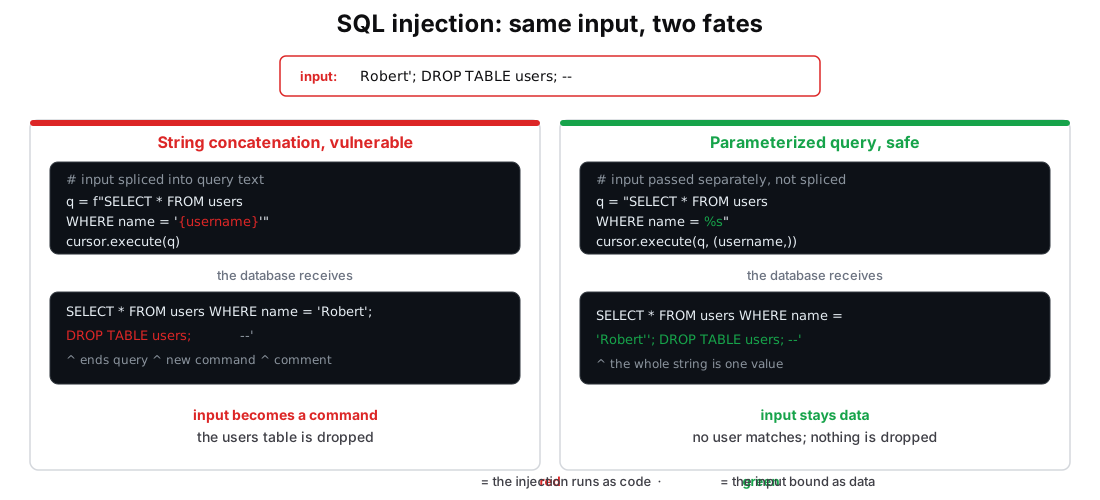 Figure: SQL injection: the same attacker input is a command in a concatenated query but harmless data in a parameterized oneThe same attacker input, Robert semicolon DROP TABLE users dash dash, takes two fates. On the left (red), string concatenation splices it into the query text, so the database runs DROP TABLE users and the table is gone. On the right (green), a parameterized query binds it as a single value, so the database looks for a user literally named that whole string, finds none, and nothing is dropped. Color key: red is the injection executing as code, green is the input bound as data.
Figure 2. The same input can act as SQL or as data. String concatenation lets an attacker terminate a string literal and inject a new command, so DROP TABLE users executes. A parameterized query sends values separately from SQL text, so the database treats the input as one value and executes no injected command. Parameterize every query and never concatenate input into SQL.
Module 6 Capstone: Power Cuts Both Ways
In Module 1 you saw that SQL is powerful: a few declarative SELECT and JOIN statements move enormous amounts of data. Here in Module 6 you see the other edge. That same power means one mistake, a single concatenated string, lets an attacker turn your query engine against you. SQL injection is just an attacker hijacking your syntax to run their own SELECT and DROP.
Do not trust the network. Do not trust the user. Verify every query.