Data Privacy: The Netflix Challenge
Concept. "Anonymized" data rarely stays anonymous. Removing names leaves quasi-identifiers. Rare combinations of attributes let a linkage attack join the dataset against public data and recover identities. k-anonymity and differential privacy give formal privacy guarantees by trading accuracy for privacy.
Intuition. Netflix released 100M "anonymized" ratings for a $1M prize in 2006. Researchers joined those ratings to public IMDB reviews on shared (movie, rating, date) pairs and re-identified users in 2007. About 8 ratings with dates make you roughly 99% unique, so the ratings acted as identifiers.
Anonymous Is Not Private
Netflix had three options for the prize dataset: release it with names (an obvious breach), keep it private (safe, but no competition), or release it with random IDs in place of names. They chose the random IDs and assumed that broke the link to real people. It did not.
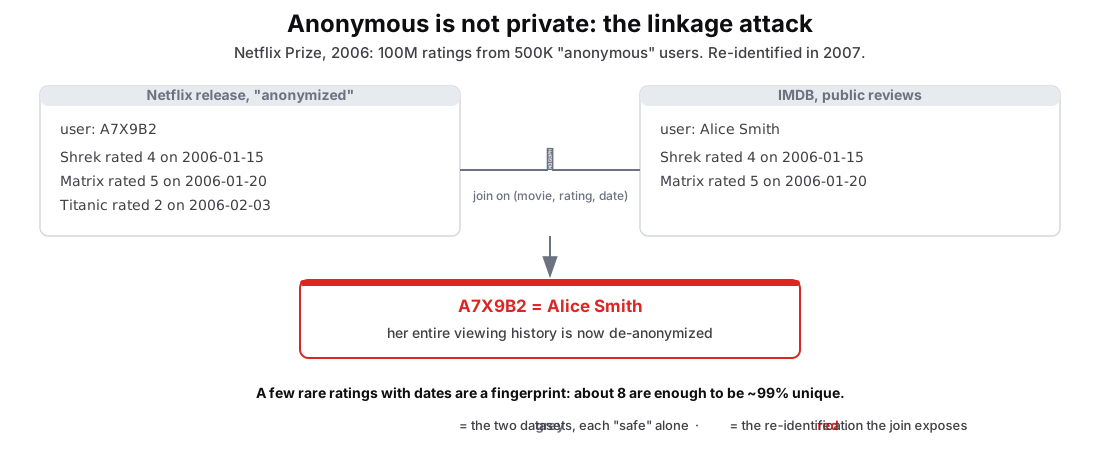 Figure: The linkage attack: joining anonymized Netflix data to public IMDB reviews re-identifies a userTwo grey datasets sit side by side. The Netflix release is anonymized: user A7X9B2 rated Shrek and Matrix on specific dates. Public IMDB reviews carry the same rare movie, rating, and date pairs under the real name Alice Smith. Joining the two on those shared pairs yields a red result: A7X9B2 equals Alice Smith, exposing her whole history. Color key: grey is the two datasets, red is the re-identification.
Figure 1. A join on (movie, rating, date) can map an anonymous ID to a real name. A user's ratings form a rare pattern across movies, scores, and dates. The same user can publish some of those ratings on IMDB under a real name. The join links the random Netflix ID to that name and reveals the rest of the Netflix history under the same ID.
Privacy Attacks
| Attack | How it works | Example | Prevention |
|---|---|---|---|
| Linkage | Join anonymous data with public data | Netflix + IMDB | Do not release individual records |
| Inference | Unique attribute combinations | DOB + gender + ZIP = 87% unique | Generalize attributes |
| Location | Unique movement patterns | 4 locations = 95% unique | Aggregate or add noise |
| Temporal | Timing patterns reveal identity | login and activity times | Round timestamps |
Legal Requirements
| Regulation | Scope | Key requirement | Penalty |
|---|---|---|---|
| GDPR | EU citizens | Data stays in the EU or adequate countries | Up to 4% of revenue |
| CCPA | California | Right to delete personal data | $7,500 per violation |
| HIPAA | Healthcare | Protect electronic health records (ePHI) | $2M + criminal charges |
Defense Methods
Synthetic data. Generate fake records that match the statistical shape of the real data without containing any real individual. Good for development, testing, and early ML.
Differential privacy. Add calibrated noise to query results so no single person changes the answer much, while aggregate trends stay accurate. The privacy budget epsilon sets the trade-off: lower means more noise and more privacy.
| Epsilon (ε) | Privacy | Noise | Use case |
|---|---|---|---|
| 10 | Low | ±1-2% | Internal analytics |
| 1.0 | Balanced | ±10% | Research datasets |
| 0.1 | High | ±100% | Public release |
| 0.01 | Maximum | ±1000% | Highly sensitive |
-- BigQuery differential privacy
SELECT WITH DIFFERENTIAL_PRIVACY
  OPTIONS(
    epsilon = 1.0,              -- privacy budget (lower = more private)
    delta = 1e-5,               -- probability bound
    max_groups_contributed = 1  -- limit each user's contribution
  )
  diagnosis,
  COUNT(*) AS noisy_count
FROM medical_records
GROUP BY diagnosis;

-- k-anonymity: generalize, then require a minimum group size
SELECT
  age_group,   -- not exact age
  zip_prefix,  -- first 3 digits only
  COUNT(*) AS COUNT
FROM users
GROUP BY age_group, zip_prefix
HAVING COUNT(*) >= 5;
Key Takeaways
-
Your data is a fingerprint. About 8 movie ratings can uniquely identify you.
-
Anonymous is not private. Public data sources enable re-identification.
-
Combinations matter. DOB + gender + ZIP identifies 87% of Americans.
-
Math protects privacy. Differential privacy gives a provable guarantee.
-
It is always a trade-off. More privacy means less accuracy; the epsilon budget makes the choice explicit.