Why Memory Matters
Concept. Databases give applications durable memory: data survives after a computation ends.
Intuition. Algorithms and models compute. Databases preserve what those computations read and write. Here, memory means persistent storage. RAM remains volatile working memory.
What this course teaches
 Figure: Five you learn, then the modern systems you buildTop row: five capability modules, from SQL and storage on one machine through indexing, transactions, and distributed systems across many machines. Below, M6 applies those mechanisms to phones, AI-agent memory, and modern data platforms.
| M1 · SQL | M2 · Storage | M3 · Indexing | M4 · Transactions | M5 · Distributed |
|---|---|---|---|---|
| Postgres · BigQuery | Chrome · Uber | Spotify · OpenAI | Stripe · GitHub | Netflix · Kafka |
Figure 1. Each module adds one capability, and each one supports the next scale.
-
M1 shows you how to use a declarative, parallel database
-
M2 stores the rows on disk
-
M3 locates a row in milliseconds
-
M4 keeps it correct while thousands of users write at once
-
M5 runs one logical database across many machines
-
M6 applies these mechanisms to phones, AI-agent memory, and modern data platforms
The career map connects these modules to the projects and the paths they lead to. For what the course actually answers, the twenty questions and the level of the stack each is answered at are on the Modules page.
Where we start: three systems, reconstructed
We learn how the database is built by taking three real systems apart and finding the same primitive inside each one. In teaching order, from a laptop to the planet:
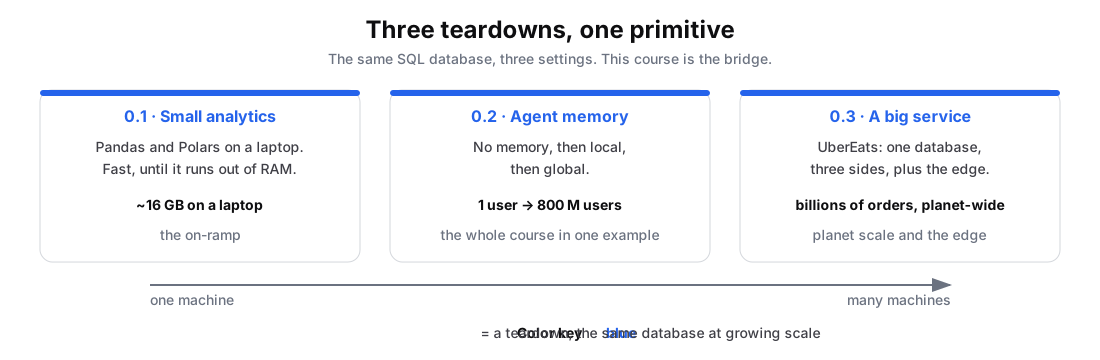 Figure: Three systems, reconstructedThree blue cards run from one machine to many. Small analytics starts with Pandas in memory and Polars streaming supported work. Agent memory separates working context from persistent memory. UberEats coordinates shared transactional state across many machines and saves unfinished phone actions through network failures.
| 0.1 · Small analytics | 0.2 · Agent memory | 0.3 · A big service |
|---|---|---|
| ~16 GB on a laptop | 1 user → 800 M users | billions of orders, planet-wide |
| the on-ramp | the whole course in one example | planet scale and the edge |
Figure 2. Three case studies move from working state on one machine to persistent state across many machines. Modules 1 through 6 explain the mechanisms underneath.
0.1 Pandas: Deconstructing Small Analytics. Pandas starts in memory. Polars extends the range of one machine with lazy and streaming execution. What changes when the workload needs more than one machine?
0.2 Claude & OpenAI: Deconstructing Agent Memory. How does an agent preserve decisions outside its context window and retrieve them for a later request? What changes between local memory and a global product?
0.3 UberEats: Deconstructing a Big Service. How does a three-sided service coordinate shared state at scale? How does its driver app keep working through a network interruption?
Across all three cases, volatile state supports the current computation. Persistent storage carries data across processes, sessions, devices, and machines.
By the end of this course, you can design one. Start with 0.1 Pandas: Deconstructing Small Analytics.